Can You Get an Accurate Blood Pressure Reading From the Forearm
Blood pressure may be the vital sign we measure out the nigh and understand the least
Nurses and physicians often argue over differences betwixt arterial line and non-invasive blood pressure level (NIBP) gage readings. Revised guidelines for management of loftier blood pressure level increased thresholds for diagnosing and treating hypertension, causing farther debate and controvery [one].
To make the all-time use of blood pressure monitoring equipment, it is helpful to have an insight into how the equipment works and the likely sources of fault that can affect readings. Download a guide to these tips to proceed with y'all for quick reference.
The most common claret pressure reading mistakes are:
- Using the wrong-sized cuff
- Incorrect patient positioning
- Incorrect cuff placement
- Normal reading prejudice
- Not factoring in electronic units correctly
Here'southward what many of us practise wrong, and how to take a blood pressure reading:
1. You're using the wrong-sized gage
The about common mistake when using indirect claret pressure level measuring equipment is using an incorrectly sized cuff. A BP cuff that is too large volition requite falsely low readings, while an overly small cuff will provide readings that are falsely high.
The American Heart Association publishes guidelines for blood pressure level measurement [two]. recommending that the float length and width (the inflatable portion of the cuff) should be 80 pct and 40 percentage respectively, of arm circumference. Near practitioners find measuring bladder and arm circumference to be overly time consuming, so they don't exercise it.
The most applied fashion to speedily and properly size a BP cuff is to pick a cuff that covers two-thirds of the altitude between your patient'due south elbow and shoulder. Carrying at least 3 cuff sizes (big developed, regular adult, and pediatric) will fit the majority of the adult population. Multiple smaller sizes are needed if you often treat pediatric patients.
Korotkoff sounds are the noises heard through a stethoscope during cuff deflation. They occur in 5 phases:
- I – get-go detectable sounds, corresponding to appearance of a palpable pulse
- Two – sounds become softer, longer and may occasionally transiently disappear
- 3 – change in sounds to a thumping quality (loudest)
- IV – pitch intensity changes and sounds become muffled
- V – sounds disappear
In their 1967 guidelines, the AHA recommended that clinicians record the systolic BP at the start of stage I and the diastolic BP at start of phase IV Korotkoff sounds. In their 1981 guidelines, the diastolic BP recommendation changed to the starting time of stage V [2].
2. You've incorrectly positioned your patient'due south body
The second most common error in BP measurement is incorrect limb position. To accurately assess blood flow in an extremity, influences of gravity must be eliminated.
The standard reference level for measurement of blood pressure by any technique — directly or indirect — is at the level of the middle. When using a gage, the arm (or leg) where the gage is practical must be at mid-middle level. Measuring BP in an extremity positioned to a higher place heart level will provide a falsely low BP whereas falsely high readings will be obtained whenever a limb is positioned beneath heart level. Errors tin can be significant — typically 2 mmHg for each inch the extremity is above or below heart level.
A seated upright position provides the most accurate blood pressure, equally long as the arm in which the pressure is taken remains at the patient'southward side. Patients lying on their side, or in other positions, tin can pose bug for authentic force per unit area measurement. To correctly appraise BP in a side lying patient, concur the BP gage extremity at mid center level while taking the pressure. In seated patients, exist certain to get out the arm at the patient's side.
Arterial pressure level transducers are discipline to similar inaccuracies when the transducer is non positioned at mid-heart level. This location, referred to as the phlebostatic axis, is located at the intersection of the quaternary intercostal space and mid-chest level (halfway betwixt the inductive and posterior chest surfaces.
Note that the mid-axillary line is often not at mid-breast level in patients with kyphosis or COPD, and therefore should non be used every bit a landmark. Incorrect leveling is the primary source of mistake in direct pressure measurement with each inch the transducer is misleveled causing a one.86 mmHg measurement fault. When above the phlebostatic axis, reported values volition be lower than bodily; when below the phlebostatic centrality, reported values will exist higher than actual.
3. You've placed the cuff incorrectly
The standard for blood pressure cuff placement is the upper arm using a cuff on bare skin with a stethoscope placed at the elbow fold over the brachial avenue.
The patient should be sitting, with the arm supported at mid heart level, legs uncrossed, and not talking. Measurements tin can be made at other locations such as the wrist, fingers, feet, and calves but volition produce varied readings depending on distance from the heart.
The hateful pressure level, interestingly, varies little between the aorta and peripheral arteries, while the systolic pressure increases and the diastolic decreases in the more distal vessels.
Crossing the legs increases systolic blood pressure by ii to 8 mm Hg. About 20 per centum of the population has differences of more than ten mmHg force per unit area betwixt the right and left arms. In cases where significant differences are observed, treatment decisions should be based on the college of the two pressures.
iv. Your readings exhibit 'prejudice'
Prejudice for normal readings significantly contributes to inaccuracies in blood pressure measurement. No doubt, y'all'd be suspicious if a fellow EMT reported blood pressures of 120/lxxx on three patients in a row. Every bit creatures of addiction, man beings await to hear sounds at certain times and when inapplicable interference makes a claret force per unit area difficult to obtain, there is considerable tendency to "hear" a normal blood pressure.
Orthostatic hypotension is defined as a decrease in systolic blood pressure of 20 mm Hg or more, or diastolic blood pressure subtract of x mm Hg or more measured after three minutes of standing quietly.
There are circumstances when BP measurement is but not possible. For many years, trauma resuscitation guidelines taught that rough estimates of systolic BP (SBP) could be made by assessing pulses. Presence of a radial pulse was thought to correlate with an SBP of at least 80 mm Hg, a femoral pulse with an SBP of at least 70, and a palpable carotid pulse with an SBP over threescore. In contempo years, vascular surgery and trauma studies have shown this method to exist poorly predictive of actual blood pressure [3].
Racket is a factor that can also interfere with BP measurement. Many ALS units comport doppler units that measure out claret menses with ultrasound waves. Doppler units dilate sound and are useful in high noise environments.
BP by palpation or obtaining the systolic value by palpating a distal pulse while deflating the blood pressure level gage by and large comes within 10 – twenty mmHg of an auscultated reading. A pulse oximeter waveform can likewise exist used to measure render of blood period while deflating a BP gage, and is equally accurate equally pressures obtained by palpation.
In patients with circulatory assist devices that produce not-pulsatile flow such as left ventricular assist devices (LVADs), the only indirect means of measuring flow requires use of a doppler.
The return of menstruation signals over the brachial avenue during deflation of a blood pressure cuff in an LVAD patient signifies the mean arterial pressure level (MAP). While a normal MAP in adults ranges from 70 to 105 mmHg, LVADs do non function optimally against higher afterload, and so mean pressures of less than 90 are oft desirable.
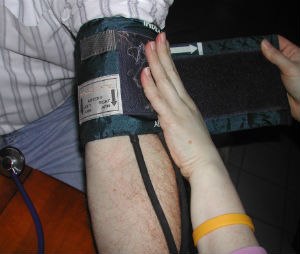
Clothing, patient access, and cuff size are obstacles that frequently interfere with conventional BP measurement. Consider using alternate sites such as placing the BP cuff on your patient'south lower arm above the wrist while auscultating or palpating their radial artery. This is particularly useful in bariatric patients when an appropriately sized cuff is not available for the upper arm. The thigh or lower leg can exist used in a similar manner (in conjunction with a pulse indicate distal to the cuff).
All of these locations are routinely used to monitor BP in infirmary settings and generally provide results simply slightly different from traditional measurements in the upper arm.
5. You lot're not factoring in electronic units correctly
Electronic blood pressure units also called Non Invasive Blood Pressure (NIBP) machines, sense air pressure level changes in the cuff acquired by blood flowing through the BP cuff extremity. Sensors judge the Mean Arterial Force per unit area (MAP) and the patient'south pulse rate. Software in the machine uses these two values to summate the systolic and diastolic BP.
To assure accuracy from electronic units, it is important to verify the displayed pulse with an bodily patient pulse. Differences of more than than ten percent volition seriously alter the unit's calculations and produce incorrect systolic and diastolic values on the display screen.
Given that MAP is the merely force per unit area actually measured by an NIBP, and since MAP varies niggling throughout the body, information technology makes sense to use this number for treatment decisions.
A normal adult MAP ranges from 70 to 105 mmHg. Equally the organ most sensitive to force per unit area, the kidneys typically require an MAP in a higher place sixty to stay live, and sustain irreversible impairment across xx minutes below that in most adults. Because individual requirements vary, most clinicians consider a MAP of lxx equally a reasonable lower limit for their developed patients.
Increased employ of NIBP devices, coupled with recognition that their displayed systolic and diastolic values are calculated while only the mean is actually measured, have led clinicians to pay much more than attention to MAPs than in the past. Many progressive hospitals order sets and prehospital BLS and ALS protocols have begun to treat MAPs rather than systolic blood pressures.
Finally, and especially in the critical care send environment, providers will encounter patients with significant variations between NIBP (indirect) and arterial line (directly) measured claret pressure values.
In the past, depending on patient status, providers have elected to utilise 1 measuring device over another, often without clear rationale too a belief that the selected device was providing more accurate blood pressure information.
In 2013, a group of ICU researchers published an analysis of 27,022 simultaneous art line and NIBP measurements obtained in 852 patients [4]. When comparing the a-line and NIBP readings, the researchers were able to decide that, in hypotensive states, the NIBP significant overestimated the systolic claret pressure level when compared to the arterial line, and this difference increased equally patients became more hypotensive.
At the same time, the hateful arterial pressures (MAPs) consistently correlated between the a-line and NIBP devices, regardless of pressure. The authors suggested that MAP is the most accurate value to tendency and treat, regardless of whether BP is being measured with an arterial line or an NIBP. Additionally, supporting previously believed parameters for acute kidney injury (AKI) and bloodshed, the authors noted that a MAP beneath 60 mmHg was consistently associated with both AKI and increased mortality.
Since 1930, blood pressure measurement has been a widely accepted tool for cardiovascular assessment. Even under the often adverse weather encountered in the prehospital or transport environment, providers tin accurately measure blood pressure level if they empathise the principles of blood menses and common sources that introduce error into the measurement process.
Blood force per unit area assessment tips
Proceed learning virtually claret pressure assessment by reading how to mitigate NIBP and auscultating innacuracies by watching the plethysmography waveform on your pulse oximeter and noting the mean arterial pressure.
Read next: Learn how to read a MAP.
References:
1. James PA, Oparil S, Carter BL, et al. 2014 Show-Based Guideline for the Direction of High Blood Pressure in Adults: Report From the Panel Members Appointed to the Eighth Articulation National Committee (JNC 8). JAMA. 2014;311(v):507-520. (Available at: http://jama.jamanetwork.com/article.aspx?articleid=1791497)
2. Pickering TG, Hall JE, Appel LJ, et al. AHA Scientific Statement: Recommendations for claret pressure measurement in humans and experimental animals, part ane: blood pressure level measurement in humans. Hypertension. 2005; 45: 142-161. (Available at: https://hyper.ahajournals.org/content/45/1/142.full)
three. Deakin CD, Depression JL. Accuracy of the advanced trauma life back up guidelines for predicting systolic claret pressure using carotid, femoral, and radial pulses: observational study. BMJ. 2000; 321(7262): 673–674. (Bachelor at: http://world wide web.ncbi.nlm.nih.gov/pmc/manufactures/PMC27481/)
4. Lehman LH, Saeed M, Talmor D, Mark R, Malhotra A. Methods of blood pressure measurement in the ICU. Crit Care Med. 2013;41:34-40.
This article, originally posted Apr. 9, 2014, has been updated.
Fill out the grade below to download a guide to reading blood pressure.
Near the author
Mike McEvoy, PhD, NRP, RN, CCRN is the EMS Coordinator for Saratoga Canton, New York and a paramedic supervisor with Clifton Park & Halfmoon Ambulance. He is a nurse clinician in cardiothoracic surgical intensive care at Albany Medical Center where he besides Chairs the Resuscitation Committee and teaches critical care medicine. He is a lead writer of the "Disquisitional Intendance Transport" textbook and Informed® Emergency & Disquisitional Care guides published past Jones & Bartlett Learning. Mike is a correspondent to EMS1.com and a popular speaker at European monetary system, Burn down, and medical conferences worldwide. Contact Mike by email.
Source: https://www.ems1.com/ems-products/medical-monitoring/articles/5-errors-that-are-giving-you-incorrect-blood-pressure-readings-zJNOHnFJZOocufoS/
0 Response to "Can You Get an Accurate Blood Pressure Reading From the Forearm"
Post a Comment